
The 12 Pillars of an Effective AI Operator (and Why Every AI Team Needs One)
Written By: Shane Clark on May 18, 2026
What does an AI operator do?
An AI operator directs AI to build or do work and takes responsibility for catching what the AI gets wrong. The role covers twelve pillars grouped across five layers: Experience, Truth, Runtime, Growth, and Human. The operator is the person who judges whether the output is correct, complete, and safe to ship.
I build software with AI every day. It is fast, and most of the time the work it hands back looks finished. That word, looks, is the whole problem, and learning to see past it is the entire job of an AI operator.
AI can produce the work. What it cannot do is tell you when the work is wrong. From the AI’s side, a confident answer and a correct answer look identical. There is no internal signal that quietly says, I am not sure about this one.
The person who fills that gap is what I call an AI operator. After two months of doing the job myself, on real client projects, I can tell you the role is real, it is learnable, and it comes down to twelve things. I call them the twelve pillars, and this post walks through every one.
Here is why it matters. Most people building with AI today check two things: does it look right, and does it run. Those two checks miss the other ten. The twelve pillars are the full field of vision.
Why the AI operator role exists now
Three years ago, this role did not exist, because AI was not producing finished-looking work at this volume. Now it is, and that changes where the bottleneck sits.
The thing to understand about AI is that it is jagged. It is sharp at one task and clumsy at the next, with no obvious pattern to which is which. Moreover, it is confident when it is wrong, and it states a wrong answer in exactly the same tone as a right one. It is also brittle, because it handles the case you showed it and falls apart on the case you did not. The companies that build these models, including Anthropic, are open about these limits. None of this makes AI bad. Instead, it makes AI something that needs a human judgment layer on top of it.
That judgment layer is the AI operator. Importantly, an operator is not necessarily a developer. The role is not to write the code. It is to look at what the AI produced and know what to check, what is wrong, and when a problem is past your own skill and needs a specialist. Part of the work even happens before the AI starts, by handing it a clear brief in a project context file your AI tools can follow. This is the same shift I described in moving from outsourced teams to AI-assisted insourcing. Fewer hands do the work, yet every remaining hand needs sharper judgment.
The 12 pillars of AI operation
Here is what I learned by cleaning up after myself for two months. AI-built software does not break at random. Instead, it breaks in a consistent set of ways, twelve of them, and once you can see all twelve you stop being surprised.
I group the pillars into five layers. Work down the layers in order and you have inspected the whole product, not just the part you can see. Running all twelve in sequence is the same discipline behind a proper AI automation audit. Each pillar below comes with a plain definition, one real example, and the cost when it gets missed.
Layer one: the experience your user touches

The first layer is everything the user sees and moves through. It is the cheapest layer to fix, and it is the first one a client judges you on.
UI is the visual layer, the bugs you catch just by looking. Think of buttons in a row sitting at different heights, boxes with uneven spacing, or a color that is not quite the brand color. None of it breaks anything. Still, it tells the user within three seconds that the work is amateur.
UX is the path a person takes to finish a task, across screens rather than on one screen. In practice, AI is good at building a single screen and weak at connecting screens into a flow. So you get dead ends, a popup with no way out, or a setup step that collects data nobody uses. The cost is people who quit halfway.
Accessibility is whether everyone can use the product, including people on a keyboard, people with low vision, and people on a phone. By default, AI ships popups you cannot close without a mouse and text too faint to read. When this fails, real people are locked out, and the WCAG accessibility standard exists partly because that exclusion can also carry legal risk.
Content is the words: buttons, labels, and error messages. AI reaches for generic phrasing because generic phrasing fills its training data. It labels a button Submit when that button charges a credit card. Another message says Something went wrong and gives no hint of what to do next.
For the full inspection guide on the four visible pillars, see the AI experience layer post.
Layer two: the truth underneath

The second layer never shows up on the screen, which is exactly why it is dangerous. A bug here passes every visual check and waits.
Data Integrity is whether you can trust a number. Picture a form with a free-text country field. One person types US, the next types USA, and the next types United States. Three people, one country, three values. The form worked. Months later, your report of customers by country is quietly wrong, and you already made decisions on it.
Relational Database is whether the data is modeled correctly, meaning the things in your system connect the right way. For example, I once watched AI build a customer record where the customer was a house. A customer is a person. A house is something a person owns, and one person can own several. Make the house the customer, and that person’s billing, contact details, and history splinter across unconnected records.
Logic is whether the business rules are right across every case, not only the obvious one. Tell AI that subscribers get 25 percent off and it will build exactly that. However, it will not ask 25 percent off what, which subscribers qualify, or whether the discount stacks with a coupon. It handles the normal case and breaks on the edges.
For the full inspection guide on the three invisible pillars, see the AI truth layer post.
Layer three: what happens when it runs
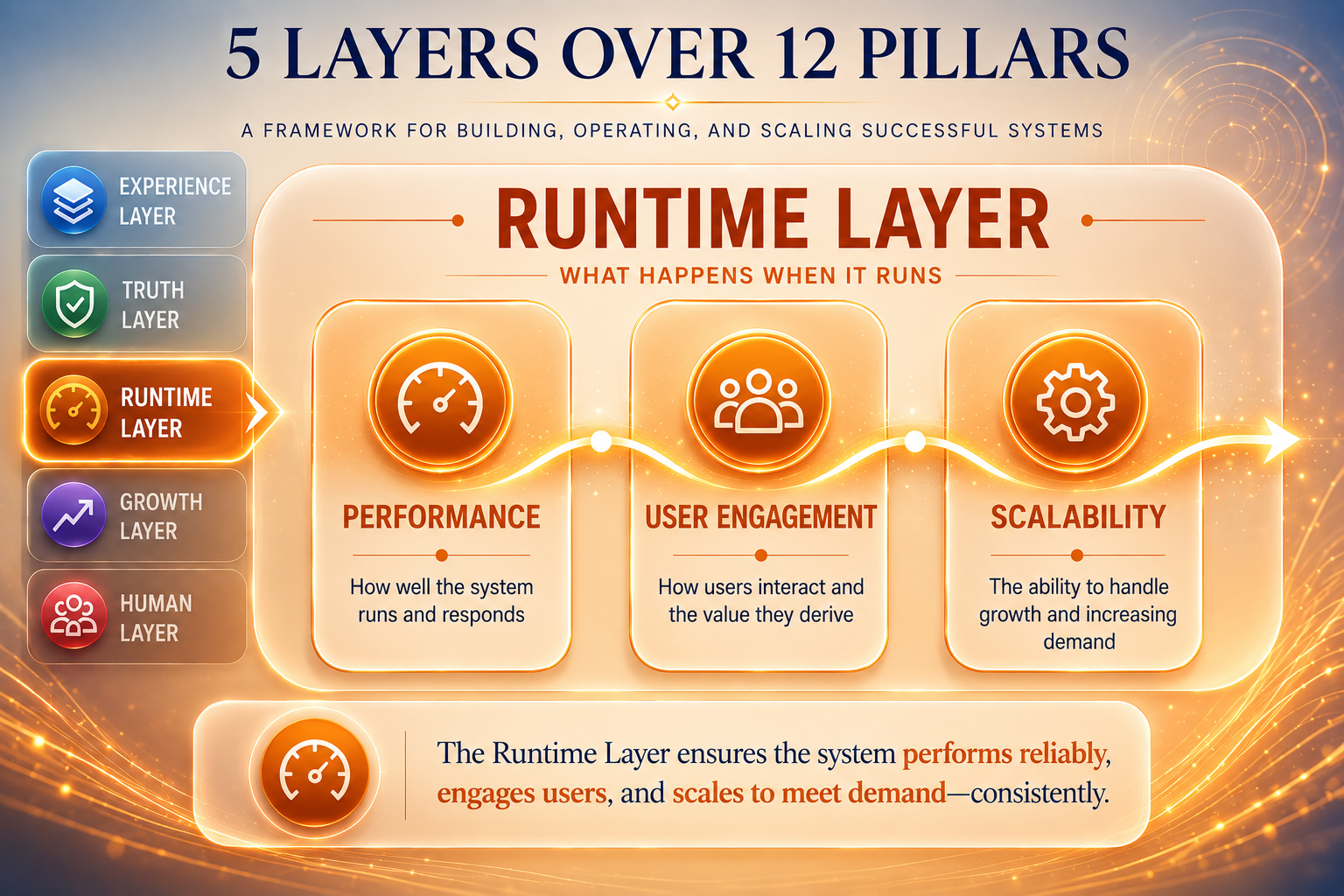
The third layer is about the live product under real use, not the version sitting still on a developer’s screen.
Performance is what the slowest real user feels while they wait. It is not the number on a fast developer machine. Google’s Core Web Vitals grade a page the same way, by real loading and responsiveness rather than by lab numbers. Typically, AI builds pages that show nothing at all until everything is ready, then snap into place. That can take the same number of seconds as a fast page and still feel broken, because nothing told the user it was working.
User Engagement is whether the system keeps the user informed. For instance, you click save, nothing visibly happens, so you click again, and now there are two records. Or a long process runs with no progress bar, the user assumes it froze, and they hit the back button, which breaks the operation. A progress bar is not decoration. Decades of research on interface response times show that past a short wait, a user needs visible feedback. The progress bar is the system saying, I have got this, do not touch anything.
For the full inspection guide on bugs that surface under real users, see the AI runtime layer post.
Layer four: what happens when it grows
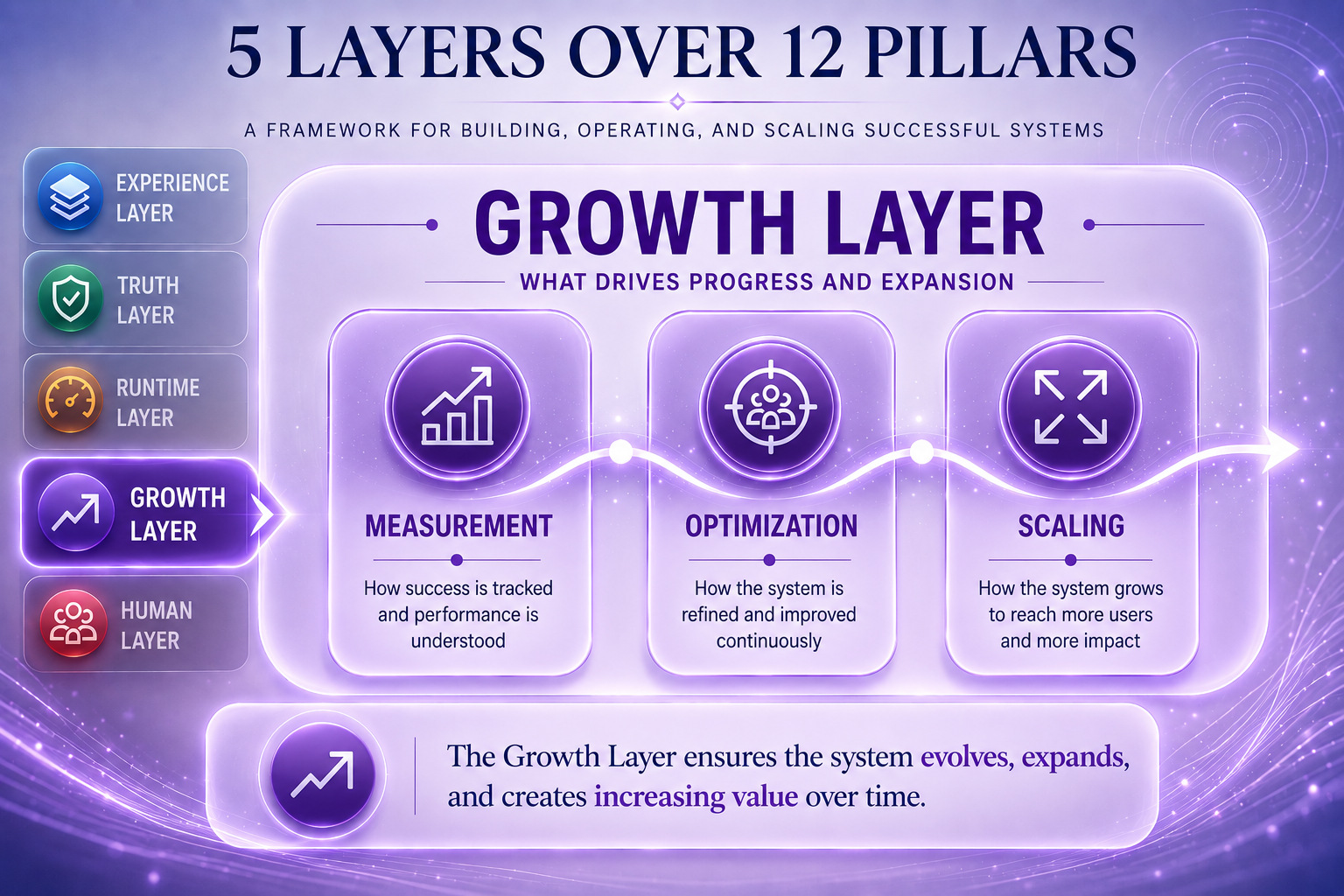
The fourth layer holds a single pillar, and it is the one people forget most often.
Scalability is the set of things that work fine small and fall apart large. A dropdown menu with twenty items is perfectly usable. The same dropdown with two thousand items is not, because you cannot scroll it or find anything in it. Nothing is wrong today. The product simply fails on the day the client finally gets busy, which is the worst possible day for it to fail. In short, scalability bugs ship invisible and surface at the worst moment.
For the full inspection guide on the one Scalability pillar, see the AI growth layer post.
Layer five: the human layer

The fifth layer is not about the software at all. Rather, it is about the people around it, and it is the layer that holds the other four together.
Communication cuts two ways. For an operator working with a client, it means saying what you found, how serious it is, and what you would do about it, before the client has to ask. For the AI itself, it means honest signals about its own work. AI will report a task as done and hand you a file that looks complete while a piece of it is quietly missing. The artifact looks finished. The signal is the lie.
Situational Awareness is the lens for everything that has not happened yet. It is looking at that twenty-item dropdown and asking what it becomes at two thousand. It is noticing what else is wired to the thing you just changed. As more software begins to act on its own, this pillar matters more, not less. It is the skill of seeing a problem before it exists.
For the full inspection guide on Communication and Situational Awareness, see the AI human layer post.
The mistakes that do not announce themselves
Look back over those twelve and one thread runs through all of them. The mistakes that matter do not announce themselves. They are invisible at the moment they are made. The form submits. The page loads. Then the feature runs. Everything passes the two checks most people make, does it look right and does it run, while the real problem sits underneath and waits.
That is why an operator who only watches the surface misses nine of the twelve. The twelve pillars are not a filing system to argue over. Rather, they are a field of vision, twelve prompts that make sure no kind of problem is nobody’s job.
One more point, because it matters most. Knowing the twelve pillars is not the same as being able to use them. Anyone can memorize a list. The real skill, the part worth paying for, is catching the bug in live work. An operator is measured by what they find, not by what they can name. For that reason, the best way to build the skill is to treat inspection as a repeatable cycle you run on every piece of work.
Why the AI operator role keeps its value
Here is the part that surprised me. The better AI gets, the more this role matters, not less.
AI keeps getting faster and more capable. Yet none of that gives it the one thing it structurally lacks, a sense of when it is wrong. As more task-level work shifts to AI, the volume of confident, finished-looking, quietly broken output goes up. Someone has to be the judgment layer, and that someone is a person, because the durable version of this skill lives in a person. It compounds. It travels from one project to the next, one client to the next, one year to the next.
So an operator who genuinely holds all twelve pillars is not doing a temporary job. They are doing a job that gets more valuable every month more work moves to AI. That is a rare thing to be able to say about any skill right now.
Want to learn the twelve pillars?
I am turning these twelve pillars into training for people who want to become effective AI operators. Not by reading a list, but by inspecting real, broken work until catching the mistakes becomes a reflex. If that is you, get in touch and I will add you to the early list. And if you would rather hand the inspection to someone who already works all twelve, that is what I do. I am Shane, and I run ShaneWebGuy, a web development and AI automation studio in Pittsburgh.
Frequently asked questions
Do you need to be a developer to be an AI operator?
No. An AI operator does not have to write code. The job is awareness and judgment: knowing what to inspect, recognizing when something is off, and knowing when a problem is past your own skill and needs a specialist. Recognizing the limit of your own competence is itself one of the twelve pillars, the one called Situational Awareness.
What are the 12 pillars of AI operation?
The twelve pillars are UI, UX, Accessibility, Content, Data Integrity, Relational Database, Logic, Performance, User Engagement, Scalability, Communication, and Situational Awareness. They group into five layers: the experience the user touches, the truth underneath, what happens when the software runs, what happens when it grows, and the human layer around it.
Why does the AI operator role matter now?
It matters because AI now produces finished-looking work at high volume and cannot tell when that work is wrong. From the AI's side, a confident answer and a correct answer look identical. Someone has to be the judgment layer that catches the difference, and that demand grows as more work moves to AI.
How do you become an effective AI operator?
Practice on real work. Read the twelve pillars once to learn the map, then spend your time inspecting actual software, ideally work with bugs planted in it, until catching problems across all twelve becomes automatic. Knowing the pillars is the easy part. Catching the bug in live work is the skill that takes repetition.
What is the difference between an AI operator and a developer?
A developer writes and builds the code. An AI operator inspects and judges what gets produced, whether the AI or a developer produced it. The two roles overlap, and a developer can be an excellent operator. Still, the operator skill is its own thing, because it is about catching problems across twelve dimensions rather than about writing software.
Can AI just check its own work?
Not reliably. AI has no internal signal for its own uncertainty, so it cannot flag the answers it got wrong. It will review its work and report it as fine, with the same confidence it showed the first time. That blind spot is the reason the human AI operator role exists and keeps its value.
