
AI Is Shifting Programming From Execution to Judgment
Written By: Shane Clark on March 14, 2026
How is AI changing programming roles?
AI is changing programming roles by moving value away from typing code and toward judgment. Writing code is no longer the bottleneck. What matters now is deciding what to build, understanding the business, and checking the output. I spend more time on direction and QA than on raw execution.
Programming is changing, but not in the way most people expect. Most conversations focus on whether AI will replace developers or how quickly code can be generated. That framing misses the real shift. Today, the value is moving away from execution and toward judgment, context, and decision-making. Writing code still matters, but deciding what to build and why now carries more weight.
Once you start building real systems with AI, this becomes obvious. You can describe a feature and see a working version almost immediately. From there, you iterate quickly, adjust details, and refine the outcome without much friction. However, that same speed exposes a new problem. If your thinking is off, the output will be wrong just as fast. When instructions lack clarity, results start to drift. And without a clear understanding of the business or the user, the final product may work but still feel off.
At that point, a clear separation starts to appear. Some people become far more effective because they can think through systems and guide AI with intention. Others produce more output than ever, yet introduce more mistakes, more rework, and less impact. The difference does not come down to technical skill alone. Instead, it comes down to awareness, context, and the ability to evaluate what is actually happening.
The Shift From Execution to Judgment
For years, programming revolved around execution. A developer received instructions and translated them into working code. Strong syntax, structure, and implementation defined success. At the time, that model made sense because execution created the main constraint.
Now that dynamic has changed. AI handles large portions of execution in seconds. Code can be generated, refactored, and debugged almost instantly. With a clear prompt, entire features can come together without the same manual effort.
Because of that, value shifts upward. It no longer sits primarily in building. Instead, it sits in deciding. The person who understands what needs to be built, how it should behave, and which tradeoffs matter now holds more leverage than someone focused only on execution.
Programming itself does not disappear. Rather, the role evolves. The core skill now centers on understanding systems well enough to guide their creation and evaluate their results.
Why Execution Is No Longer the Bottleneck
In the past, execution required time, focus, and consistent effort. Developers spent hours writing code, resolving errors, and testing changes. Even small updates could slow progress.
Today, AI removes much of that friction. It can handle repetitive patterns, generate structures, and suggest solutions almost instantly. As a result, building takes less time, and iteration happens much faster.
When execution becomes easier, it stops limiting progress. Instead, thinking becomes the constraint. You need to define the problem clearly, give precise instructions, and verify the output.
As a result, people who rely only on execution begin to struggle. If someone only builds what they are told, they compete with a system that moves faster and cheaper. The real advantage now comes from understanding what should be built and why it matters.
How AI Rewrites the Developer Workflow
Traditionally, development followed a linear path. A business defined a need, requirements were written, and a developer built the solution step by step. Feedback moved slowly, and each phase depended on the previous one.
With AI, that structure compresses. Instead of rigid stages, the process becomes a series of rapid loops. You describe a problem, generate a solution, review it, and refine it almost immediately. Each cycle moves you closer to the desired outcome.
Because of this, the nature of work changes. You are no longer just following a fixed plan. Instead, you shape the solution in real time. You can test ideas quickly, explore alternatives, and adjust based on what you observe.
In this environment, the workflow shifts from execution to direction. You guide AI through iterations and refine the result with each pass. That requires awareness of context, clarity in communication, and the ability to recognize when something is not quite right.
From Writing Code to Writing Instructions
Another noticeable change involves how work gets expressed. Instead of writing every line manually, you now write instructions that define what the code should do.
Because of that, instruction quality becomes critical. Clear, structured, and context-aware instructions lead to stronger results. On the other hand, vague instructions produce inconsistent outcomes.
As a result, communication becomes a core skill. You need to define behavior, set constraints, and think through edge cases. Rather than focusing only on execution, you focus on outcomes and intent.
At the same time, instruction alone is not enough. You still need to review what AI produces. That includes checking for correctness, usability, and alignment with the original goal.
In the end, instruction and evaluation replace traditional execution. Those who can do both well will move faster and build stronger systems in this new environment.
Why Situational Awareness Is Now the Most Valuable Skill
Situational awareness is becoming the defining skill in modern development. It goes beyond knowing how to build something. It focuses on understanding how everything connects, how users behave, and what actually matters in the real world.
When you work with AI, you quickly realize that building is no longer the hard part. You can generate features, adjust logic, and iterate quickly. However, knowing what to change, what to improve, and what to leave alone requires a different level of thinking.
For example, two people can look at the same system and see completely different things. One might say everything works fine. The other might notice friction, confusion, or unnecessary steps. That second person creates more value, even if they write less code.
Situational awareness shows up in small details. It appears in how someone evaluates a user flow, how they question assumptions, and how they anticipate problems before they happen. Over time, those small improvements compound into better systems.
As AI continues to handle execution, this skill becomes even more important. The people who can see what others miss will consistently outperform those who simply follow instructions.
Why Business Understanding Can No Longer Be Separated From Development
Development no longer exists in isolation. The closer you get to real systems, the more you see that technical decisions and business outcomes are tightly connected.
When someone understands how a business operates, they make better decisions. They simplify flows to improve conversions, remove unnecessary steps that create friction, and align features with real business goals instead of adding complexity.
Without that understanding, the work starts to drift. A feature might function correctly but fail to support the business. A workflow might look complete but create confusion for users. These issues rarely show up in code. They show up in outcomes.
AI makes this gap more visible. It can build exactly what you describe. If your instructions do not reflect the business context, the result will miss the mark.
This is why development and business thinking are merging. The person building the system must also understand why it exists. That connection leads to better decisions, faster iteration, and stronger results.
The Difference Between Building and Improving
Building something and improving something require different mindsets. Building focuses on creation. Improving focuses on refinement.
In the past, most effort went into building. Teams spent time writing code, assembling features, and getting systems to function. Improvement often came later, after release, and usually in response to problems.
Now the balance has shifted. Because AI accelerates building, improvement becomes the real opportunity. You can generate a working system quickly, but making that system better requires observation and judgment.
This is where many people struggle. They stop once something works. They move on without asking whether it could be simpler, clearer, or more effective.
Improvement requires stepping back and evaluating the experience. It means asking how a user moves through the system, where confusion might occur, and what could be streamlined.
The people who focus on improvement create more value over time. They turn functional systems into effective ones.
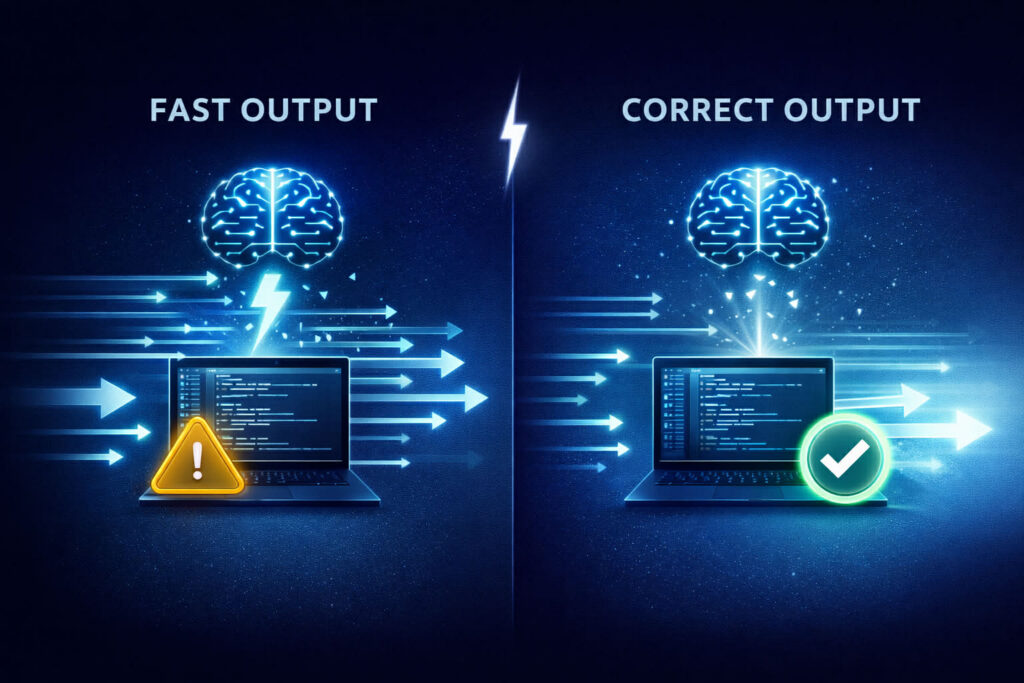
Why QA and Validation Are Becoming the Bottleneck
As execution speeds up, validation slows everything down. AI can generate output almost instantly, but someone still needs to confirm that the output is correct.
This creates a new bottleneck. It is no longer the act of building. It is the act of verifying.

In many cases, the output looks correct at first glance. It compiles, runs, and appears complete. However, subtle issues often exist beneath the surface. Edge cases may be missing. Logic may be slightly off. The user experience may not align with expectations.
Without proper validation, those issues go unnoticed until they create real problems. That leads to rework, confusion, and lost time.
Strong QA is not just about testing functionality. It involves thinking through how the system behaves under different conditions. It requires questioning assumptions and looking for gaps.
As AI continues to accelerate development, the importance of validation will keep increasing. The fastest builders will not always win. The ones who can catch mistakes and refine outputs will produce better results over time.
How AI Exposes Weak Thinking
AI does not just speed up development. It also exposes gaps in thinking much faster. In the past, weak logic or unclear direction might take hours or days to surface. Now, those issues show up almost immediately.
When someone gives vague instructions, AI still produces an output. At first glance, it may look correct. However, once you review it closely, you start to see inconsistencies, missing logic, or misalignment with the goal.
This creates a clear separation. Strong thinkers refine their instructions, adjust quickly, and improve results with each iteration. On the other hand, weaker thinkers generate more output but fail to recognize what is wrong.
Because of this, AI acts like a mirror. It reflects the quality of your thinking back at you. The better your understanding, the better the result. The weaker your understanding, the more problems appear.
The Problem With Instruction-Following Developers
For a long time, development rewarded people who could follow instructions well. A task would be defined, and the developer would execute it accurately. That approach worked when execution required significant effort.
Now that execution has become easier, that model starts to break down. If someone only follows instructions, they miss opportunities to improve the system. They do not question assumptions, and they do not look for better ways to solve the problem.
This leads to systems that technically work but feel inefficient or confusing. The deeper issue is not the code itself. It is the lack of ownership over the outcome.
Modern development requires more than execution. It requires the ability to challenge instructions when needed, refine them, and improve the final result. Without that, the system never reaches its full potential.
The Rise of the AI-Augmented Builder
A new type of builder is starting to emerge. This person does not rely on manual execution alone. Instead, they use AI as a tool to accelerate development while focusing on direction and refinement.
They think in systems, not just tasks. They understand how different parts connect and how users move through a workflow. Because of that, they can guide AI more effectively and produce better outcomes.
This approach allows one person to handle work that previously required multiple roles. Instead of separating responsibilities across teams, the AI-augmented builder manages the full loop from idea to validation.

As this model grows, it changes how teams are structured. Fewer people are needed for execution, while more emphasis is placed on awareness, decision-making, and iteration.
The Telephone Game Problem in Software Development
Every additional layer between an idea and its execution introduces the chance for distortion. When too many layers exist, development starts to resemble a telephone game. An idea begins clearly, but as it moves from one person to another, it changes slightly each time.

By the time the final output appears, it may still function, but it no longer reflects the original intent. Features get added or removed, priorities shift, and small misunderstandings turn into real issues.
This problem becomes more noticeable in complex systems. The more steps involved, the harder it becomes to maintain alignment. Even strong teams can struggle when information passes through too many hands.
AI makes an alternative possible. Instead of passing ideas across layers, one person can stay close to the process from start to finish. That reduces distortion and leads to more accurate outcomes.
The End of Traditional Outsourcing
Traditional outsourcing was built on one core advantage. It reduced cost. Businesses accepted slower communication, added layers, and occasional misalignment because the overall expense was lower.
That tradeoff made sense when execution required significant time and effort. If building software took longer, cheaper labor helped balance the equation.
AI changes that completely. Execution is no longer expensive. A single person using AI can now produce work that once required multiple developers. As a result, the cost advantage that outsourcing relied on starts to disappear.
At the same time, the weaknesses of outsourcing become more obvious. Miscommunication, delays, and lack of context create friction. What once felt manageable now feels inefficient compared to a faster, more direct workflow.

This does not mean global talent goes away. Instead, the model shifts. Value moves away from low-cost execution and toward high-context decision-making. The person closest to the business, the user, and the problem will consistently produce better results.
Because of that, work begins to move closer to the source of understanding. Fewer layers, faster iteration, and tighter feedback loops replace the traditional outsourcing model.
In the end, outsourcing does not disappear overnight. However, its role changes. It no longer dominates how software gets built, and it no longer defines the most efficient way to work.
Why Context Matters More Than Location
Context drives better decisions. When someone understands the business, the customer, and the goals, they produce stronger outcomes. That understanding becomes harder to maintain as distance increases.
Location itself is not the issue. The real issue is separation from context. The further someone is from the source of decision-making, the harder it becomes to fully understand what matters.
AI amplifies this effect. It can execute quickly, but it relies on the quality of the input. If the person guiding it lacks context, the output will miss important details.
This is why proximity to the problem becomes more valuable. The closer someone is to the business and its goals, the better they can guide the system and refine the result.
The Decline of Low-Context Work
Low-context work involves tasks that require little understanding of the bigger picture. These tasks focus on execution rather than decision-making. In the past, they made up a large portion of development work.
AI handles these tasks efficiently. It can generate code, follow patterns, and complete structured work without needing deep context. As a result, the demand for low-context roles begins to decline.
This does not eliminate work. It changes the type of work that matters. Tasks that require understanding, judgment, and adaptation become more valuable. Simple execution becomes easier to replace.
As this shift continues, the market starts to favor people who can operate with context. Those who understand systems and outcomes will have a clear advantage.
What Happens to Global Talent in an AI-Driven Economy
Global talent does not disappear. Instead, it adapts. The opportunity shifts from executing tasks to solving problems.
In many regions, this creates new possibilities. Instead of competing on cost, individuals can compete on skill, insight, and understanding. AI becomes a tool that allows them to operate at a higher level.
However, the transition is not automatic. Those who rely only on execution may find fewer opportunities. Those who develop awareness, business understanding, and system-level thinking will find more.
The playing field changes. It becomes less about where someone is located and more about how well they can think, adapt, and deliver meaningful results.
The New Competitive Advantage
The competitive advantage in development is shifting. In the past, speed and technical execution created separation. Teams that could build faster or cheaper gained an edge.
Now, that advantage looks different. Since AI handles much of the execution, speed alone no longer defines success. Instead, the advantage comes from clarity, decision-making, and the ability to guide systems effectively.
People who understand problems deeply can move faster in the right direction. They waste less time on rework and produce results that align more closely with real goals. That consistency creates a stronger long-term advantage than raw output.
As this shift continues, the best performers will not be those who produce the most code. They will be the ones who produce the best outcomes.
Why Systems Thinking Outperforms Technical Execution
Technical execution still matters, but it no longer stands alone. Systems thinking brings a broader perspective. It focuses on how different parts interact and how changes affect the overall outcome.
When someone thinks in systems, they see connections. They understand how a small change in one area can impact another. This leads to better decisions and fewer unintended consequences.
Execution without that awareness can lead to fragmented results. Features may work individually but fail to create a cohesive experience.
As AI continues to handle execution, systems thinking becomes the differentiator. It allows individuals to guide development in a way that produces stronger, more effective systems over time.
How to Identify High-Awareness Talent
Finding high-awareness talent requires a different approach than traditional hiring. Resumes, years of experience, and technical trivia no longer tell the full story. In an AI-driven environment, the more important question is whether someone can notice problems, understand context, and improve a system.
That kind of talent reveals itself through observation. When shown a workflow, a strong candidate will notice friction, confusion, and missed opportunities. They will not just describe what is there. They will explain what feels off and why it matters.
This is why practical evaluation matters more than theory. Instead of focusing only on technical tests, businesses should ask candidates to review a process, identify weaknesses, and explain how they would improve it. That reveals judgment, not just knowledge.
They should also show good validation habits. In an AI-driven workflow, checking output matters just as much as generating it. Someone who moves quickly but fails to catch mistakes will create more problems than value.
Over time, this becomes a major advantage. Businesses that can identify high-awareness talent will build better systems with fewer people and less wasted effort.
The Future of Programming Roles in an AI-Driven World
The future of programming will not revolve around who can type the most code. It will revolve around who can think clearly, guide systems effectively, and validate results with strong judgment.
Technical skill will still matter, but it will no longer stand at the center by itself. The strongest people will combine technical understanding with business awareness, systems thinking, and the ability to work well with AI.
That shift will change careers, hiring, outsourcing, and how businesses build software. Some traditional roles will shrink, while newer roles focused on direction, refinement, and validation will grow.
The people who adapt early will have a major advantage. They will not just use AI to move faster. They will use it to build smarter, reduce friction, and create better outcomes from the start.
Programming is not disappearing. It is evolving. The shift is clear. Execution is no longer the bottleneck. Judgment, context, and the ability to guide systems now define real value.
AI did not remove the need for developers. Instead, it raised the bar. It exposed weak thinking, reduced the cost of execution, and made it obvious who understands what they are building and who does not. The people who succeed in this environment will not be the ones who simply produce output. They will be the ones who can define problems, improve systems, and validate results with confidence.
This is also why the traditional models around hiring, outsourcing, and team structure are changing. Fewer layers, faster feedback loops, and stronger alignment with the business now create better outcomes. The closer you are to the problem, the more effective you become.
At ShaneWebGuy, this is exactly how work gets done. Every system is approached with a focus on real-world outcomes, not just technical execution. That means understanding the business, identifying friction, and improving workflows before and after anything gets built.
It also means using AI the right way. Not just to move faster, but to think more clearly, test ideas quickly, and refine results through strong QA and iteration. That process reduces wasted effort and produces systems that actually work the way they should.
If you are building, improving, or scaling a system, the approach matters just as much as the tools. The difference between something that works and something that performs comes down to awareness and execution working together.
That is the standard at ShaneWebGuy.
Want help with the kind of web platforms or SEO programs covered here? I’m Shane Clark, the operator at ShaneWebGuy. 21 years building US web platforms and running internet marketing systems. If you want a second pair of eyes on what’s breaking, send me a note or call (408) 915-5077. US clients only.
Frequently Asked Questions
How is AI changing programming roles today?
AI is shifting programming roles away from manual execution and toward judgment, problem definition, and system-level thinking. Developers now spend more time guiding AI and validating outputs rather than writing every line of code.
Will AI replace programmers completely?
AI will not fully replace programmers, but it will change what they do. The role is evolving from writing code to directing systems, improving workflows, and ensuring outputs align with real-world goals.
Why is execution becoming less important in programming?
Execution is becoming easier because AI can generate, debug, and refactor code quickly. As a result, the value shifts to understanding what should be built and verifying that it works correctly.
What skills are most important in AI-driven programming roles?
Situational awareness, business understanding, systems thinking, and QA skills are becoming more important. These skills help ensure that what gets built actually solves the intended problem.
How does AI impact software development workflows?
AI compresses workflows into faster iteration cycles. Instead of long, linear processes, developers now work in loops that involve prompting, reviewing, and refining results continuously.
What is the biggest mistake people make when using AI for development?
Many people assume that fast output means correct output. Without proper validation, AI-generated work can include hidden errors, missed edge cases, or misalignment with the goal.
How does AI affect outsourcing in programming?
AI reduces the cost advantage of outsourcing by lowering the cost of execution. This shifts value toward context and understanding, making proximity to the problem more important than location.
Why does business understanding matter more now?
AI builds exactly what it is told. If instructions do not reflect business goals or user needs, the result will miss the mark. Understanding the business ensures better decisions and stronger outcomes.
What is an AI-augmented builder?
An AI-augmented builder is someone who uses AI to execute tasks while focusing on direction, improvement, and validation. They manage the full workflow from idea to final result.
How should companies hire in the AI era?
Companies should prioritize candidates who can think critically, identify problems, and improve systems. Practical evaluations that test awareness and reasoning are more effective than traditional technical quizzes.
